Update: Come Together
May 12, 2019

The Eve spawning algorithm has been changed from an ever-growing spiral to a dense grid packing, based on used natural spring sites. That means that towns are much closer together than they used to be. Walk in a cardinal direction from your town well for a bit, and you're bound to encounter other settlements.
But that doesn't mean civilization will turn into one giant, sprawling mush. Just as I've brought you all together, I've also added a few other things to help you maintain some separation. You're not building that tower to heaven together quite yet.
| Update: Pump Overhaul
May 5, 2019

Problem: The longer-term pacing and difficulty of food production in an established village is supposed to be controlled by the development of higher tech water sources as the lower-tech sources run out. However, given that lower tech water sources are built on dry pond sites, and the number of ponds in a given area isn't strictly limited, many villages can get by for way too long on lower tech water sources, which undercuts the the tension and dramatic arc in these villages. Any good Eve will seek out such a location before founding a village, which means that every long-term village faces the same kind of challenge stagnation. Furthermore, the medium-tech water sources never run out, making the highest tech water source unnecessary long-term.
Solution: Wells can only be dug on natural spring sites, not ponds, and these natural spring sites are distributed evenly across the map. It's now impossible to have a town center with multiple wells clustered together. And medium-tech water sources now run out eventually, making the highest-tech source necessary long-term.
You now see the age of a grave when mousing over it. A few other bugs have been fixed, too.
Finally, forum member Clown Baby has done the heavy lifting to get a cool "time machine" server up and running, which will take you all the way back to how the game was when it launched back in February 2018. No bears. No snow. No names. No death stagger. No Eve Spacing. It looks like the same game on the surface when you first log in....
Details on how to connect to this Time Machine server are posted here:
http://onehouronelife.com/forums/viewtopic.php?id=6250
| Update: Frozen Moments
April 28, 2019

My friend once observed that as photographs age, they transcend their status as documents and move gradually into the realm of sublime art. Even the most casual, throw-away snapshots, given eighty years or so, become nothing short of jaw-dropping---windows into a forgotten world that we can barely imagine ever really existed. We also occupy a very special place in history---the place where photographs, as a relatively recent invention, only document very recent history for us. We can dream about photographic evidence of the middle ages, but we will never see it.
Now imagine people five hundred or a thousand years from now, and how they will likely be able to look at photographs that are many hundreds of years old. Even more mind-boggling, they will have access to moving images that are many hundreds of years old, where we don't even have movies of our grandparents when they were young. It seems like these kinds of multidimensional documents will serve to make distant history more real and less mysterious. That seems neat and all, but part of me likes the mystery.
And this game mostly preserves that mystery. What happened long ago? What did it look like? Who lived here? How did they dress? Now we all have a very narrow window into the past, and your photographs will be messages in bottles that wash up on the shores of the future. Damn, I'm really laying it on thick this time, aren't I? But this is profound stuff that we're dealing with here. Pictures of Grandma. Forever.
And the first in-game photos have already started showing up. Here's a good one for you:
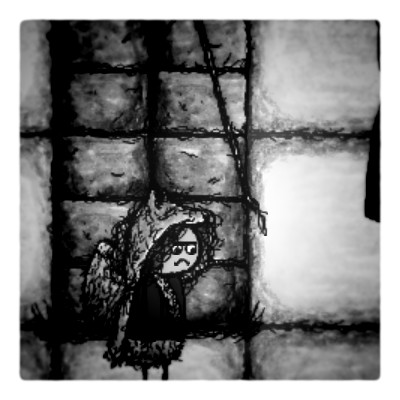
You can see the full stream here:
http://photos.onehouronelife.com/server.php?action=front_page
And check the family tree browser for people who have been tagged by a little photograph icon.
| Update: Good Fences Good Neighbors
April 21, 2019

First, the big news: Potato digging no longer wears out shovels. May you rejoice with baked, fried, or ketchup'd.
Beyond that, this week's update involves a game-changing experiment. What if individual or group ownership was an actual thing in the game?
As a designer, I have some pretty big dreams for this game, in terms of what kind of social dynamics will emerge from it. While I'm very happy with some of the complex interactions that have blossomed inside the game, I feel like some other possibilities have been stunted. Where's trade? Where are the stores? Where's resource contention? Where's crime? Where's trans-generational conflict? Where are the sheriffs? Where are the monarchs? Where are the guillotines?
Now, there are probably dozens of reasons why such things have not emerged in the game, but I'm starting with the most obvious one: how can you trade when everything is just laying there, ready for the taking? When there is no ownership?
And long ago, I did add atoms to the game that would supposedly enable ownership (walls, doors, locks, and keys). But they are so expensive to make, and such a burden to use in practice, that people have never been able to build functional ownership systems with these atoms. If it takes three lifetimes to successfully build a locked bakery before you can actually start trading your bread, your family is going to lose the thread before it ever gets off the ground.
I thought about overhauling the costs of building and locking, but such an overhaul would likely have loads of other side-effects. And furthermore, one of the biggest problems with "easy" building and locking is lack of consensus. In other words, if it's easy to lock people out, it's easy to lock people in. Here come the griefers, building a wall around the whole town and locking the door. Or maybe even skipping the whole "door" part entirely. In other words, property rights cannot be claimed unilaterally. And they aren't, actually, in real life. If a bunch of people have been using a swimming hole for ages, you can't suddenly walk up to it and say, "It's unclaimed, so it's mine now." Everyone would collectively object, including physically throwing you out of your own "property" if you were persistent enough. Thus, we have come full-circle and discovered the philosophical underpinnings of homesteading---homesteading is not quick, unrestricted, or easy for some very good reasons.
So it seems like we need a new atom here. Something a bit more abstract than walls and doors and locks. For example, to stake a mining claim on public land in the USA, you literally pound a wooden stake into the ground, nail the lid of a peanutbutter jar to the stake, write your claim on a piece of paper, and screw the paper into an empty jar, attached to the stake, like this:

And most importantly, if other people are working there, they're not going to let you stake your claim, or they're going to remove your claim after you leave. But the longer your claim goes uncontested by others, the more real it becomes.
This is essentially how the new fences and gates work. They go through a three-minute proposal phase, where people can see which area of land you intend to box in. After that, if no one objects, they can be erected, but they are still "shaky" for twenty more minutes. During that time, shaky fences are easy for anyone to remove. After that, they become permanent, though they fall apart in an hour if not maintained by someone. In other words, to claim property, you have to find a spot that no one objects to you claiming, and you have to take care of it long-term.
Gates are owned by whoever builds them, and new owners can be added verbally ("You own this" or "Sam Smith owns this"). Only the owners can open and close the gate. When the last owner dies, the gate is abandoned and falls apart. Thus, if you want to keep your gate working long-term, you need to assign a new living owner to it before you croak.
And fences are very cheap to propose and build (and remove!), making them orthogonal to the rest of the resource systems in the game. They are meant to abstractly represent consensual trans-generational property ownership.
But aside from blocking movement, there is no other explicit concept of ownership in the game. The land and items inside a fence are not inherently owned, which means that theft and other juicy interactions are still possible. And one owner who no longer has the support of the rest of the town for their ownership stands no chance. There's still strength in numbers. Beheading the queen will unlock the castle.
| Update: High Society
April 6, 2019

This update is mostly about one thing: New clothing, and lots of it.
But there are also a few key fixes under the hood. Your family's last name is remembered, even if your mother doesn't give you a name. So later, if you name your own child, they will get that "invisible" last name passed on to them. This will make family trees more coherent, with a last name shared by every named person in the tree. No more lost family names over time.
Even cooler is the new grave-mouse-over feature, which now works for all graves, not just graves for people who died in your lifetime. Family history is now apparent directly inside the game, when you visit the family grave yard. To make this work, the server remembers everyone who ever lived, and keeps a new database of grave positions for each of those people. To prevent this from growing indefinitely, people get "forgotten" after a week, or when the server restarts, and the grave position database is flushed at server startup. But if your family has been around for a while, you will see a lot of family history on the ground.
In other news, community member Futurebird has created a survey for players, which you can find here:
https://www.surveymonkey.com/r/3LKVW7P
Here are the results:
https://www.surveymonkey.com/results/SM-LRBDYL2FV/
There most likely won't be an update next week---I'm scheduled to be on vacation with my family.
|
|
|
